
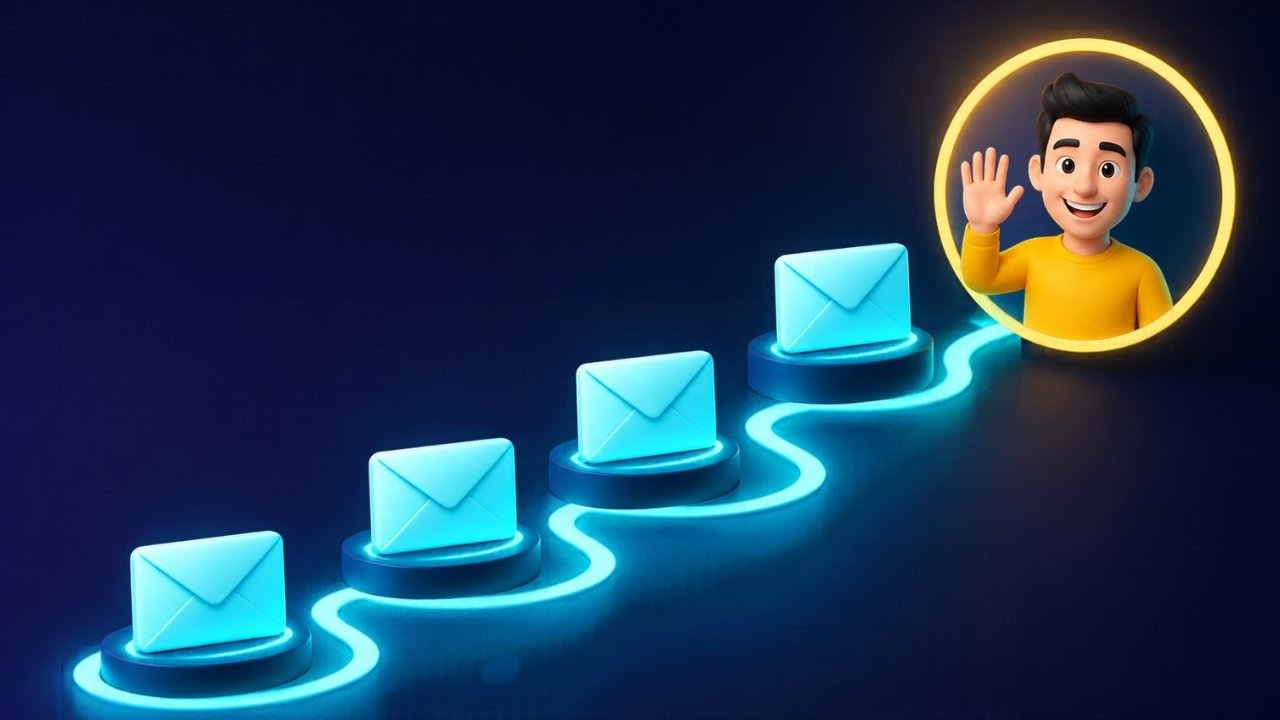
Most people who join your email list expect to hear from you straight away. That moment, just after they subscribe, is when they are most likely to open what you send. Yet many small marketers leave it to chance: a single “thanks for subscribing” message, followed by silence until the next newsletter.
A welcome sequence fixes that. It is a short, automated run of emails that introduces you, delivers what you promised and gives new subscribers a reason to keep reading. This guide walks through a simple five-email structure you can build in almost any email platform.
Why a welcome sequence is worth the effort
You write it once and it works for every new subscriber from then on. It also sets expectations. People learn what you send, how often, and what is in it for them. If you never set that tone, your first real newsletter can feel like a surprise, and surprises lead to unsubscribes and spam complaints.
It also gives you early feedback. Replies, clicks and unsubscribes in the first week tell you quickly whether your opt-in offer matches what you actually send.
Before you write: three decisions
1. Define one goal
Pick a single outcome for the sequence. It might be getting people to read your best three articles, to reply with a question, or to try a free tool. Trying to do all of these at once makes every email vague.
2. Know what you promised
Look at your sign-up form and the wording around it. Whatever you offered, whether a checklist, a template or a short guide, the first email must deliver it without making people hunt. Broken or missing downloads are the quickest way to lose trust.
3. Choose a sensible spacing
For most lists, one email on day zero, then roughly every second day for a week, works well. There is no universal rule, so treat this as a starting point and adjust based on your own open and reply rates.
The five-email structure
Email 1: Deliver and set expectations (send immediately)
Say thank you in one line, give the download or link, and explain what they will receive and how often. Keep it short. Ask them to reply if the email landed in the wrong folder, or to move it to their primary inbox; this small request can help future deliverability.
Email 2: Introduce yourself (day 1 or 2)
Tell people who you are and why you write about this subject. Stick to facts relevant to the reader: what you work on, what you have learned, and who you help. A brief personal detail makes the message human, but the focus should stay on the reader’s problem.
Email 3: Your most useful piece of advice (day 3 or 4)
Share one genuinely practical tip, or link to your best article, and explain how to apply it. This is where subscribers decide whether your emails are worth opening. Give something they can act on in ten minutes, not a vague overview.
Email 4: Address a common problem or objection (day 5 or 6)
Think about what stops your audience from getting results. It could be time, budget, technical confusion or simply not knowing where to start. Write honestly about that obstacle and offer a realistic way past it. If you have a relevant product, this is a natural place to mention it briefly, as one option among others, without pressure.
Email 5: Invite a conversation (day 7 or 8)
Ask a simple question, such as what they are working on or what they find hardest right now. Replies are valuable for two reasons: they show you what to write next, and they signal to mailbox providers that people want your messages. Close by pointing to where they can find more of your content.
Writing tips that make a difference
- Write to one person. Use “you” and keep sentences short. Read each email aloud before scheduling it.
- Use plain subject lines. A clear description of what is inside usually beats clever wording. Avoid misleading claims.
- Use one main link or action per email. Several competing buttons dilute the message.
- Send from a real name. A named sender feels more personal than a brand alone.
- Make unsubscribing easy. It keeps your list healthy and keeps you on the right side of data protection rules.
Testing and improving the sequence
Once the sequence is live, check it after the first few dozen subscribers rather than the first few. Look at which email has the lowest open rate and which gets the most clicks or replies. Change one thing at a time, such as a subject line or the placement of a link, so you know what made the difference.
Also sign up to your own list periodically. Check the timing, the formatting on mobile, and that every link and download still works. It is easy for a page to move and for a welcome email to quietly start sending people to an error.
Common mistakes to avoid
- Selling hard in the first email, before you have shown any value.
- Writing a long autobiography instead of focusing on the reader.
- Sending the whole sequence in one burst so that it feels like spam.
- Forgetting to remove new subscribers from the sequence if they buy or move to another list.
- Never reviewing it after launch.
Practical next steps
Start by drafting just emails one and three. Those two do the most work: one delivers your promise and the other proves your value. Add the others once those are live and you have a feel for how your audience responds.
If your opt-in offer needs a polished download, a short guide or checklist is often enough. You can browse tools and templates that help you produce them in the Altratom shop, including software for creating eBooks and 3D product covers for Windows.